
Live auction, silent auction, paddle raiser, golden tickets, wine pulls, raffles, ring tosses. There are SO many ways to raise money at a fundraising gala.
But here's the thing: Just because you can include a fundraising activity doesn't mean you should.
Every activity takes time, energy, money, and people to pull off. And some bring in a whole lot more than others.
So how do you decide what actually deserves a place in your gala?
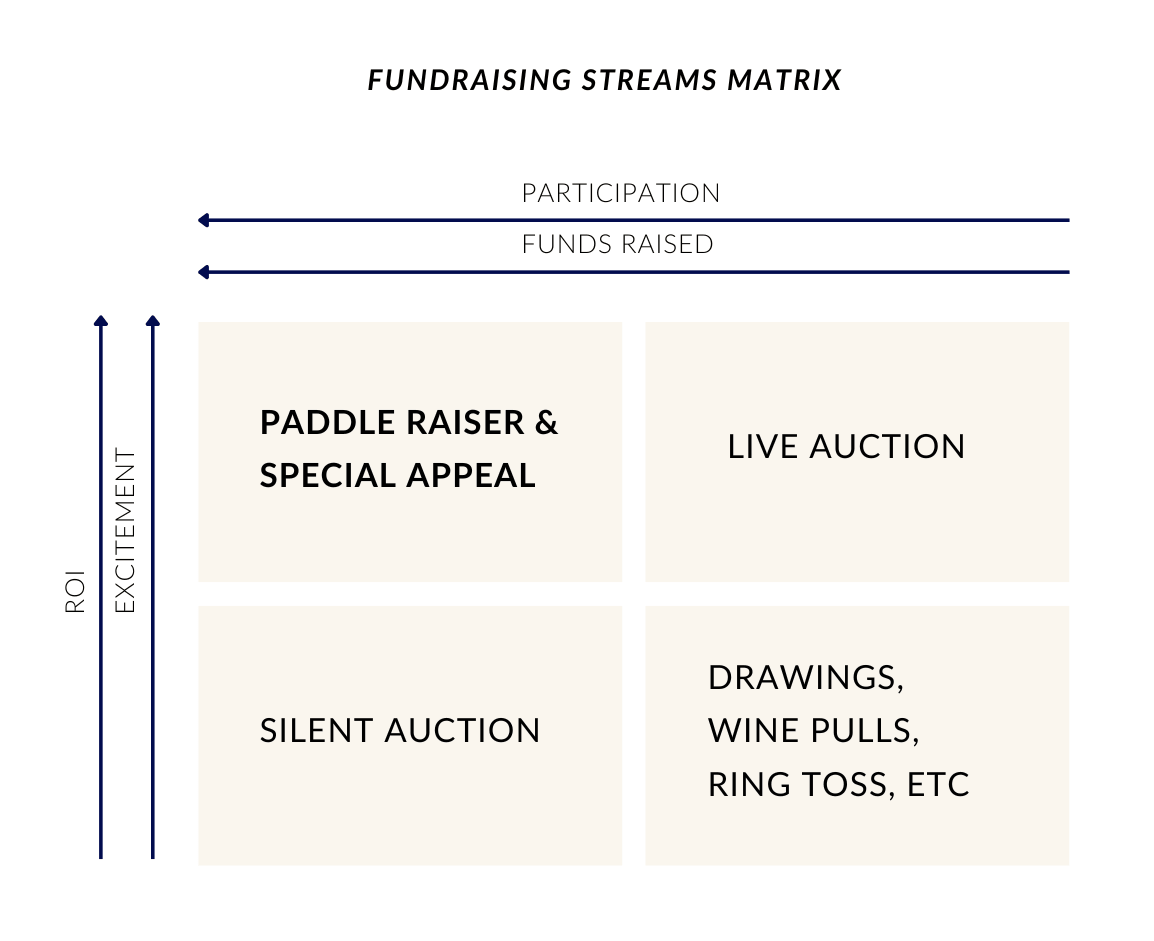
That's where my Fundraising Streams Matrix comes in. It's a simple way to evaluate your options, focus your resources, and build a fundraising strategy that makes sense for your donors, your team, and your bottom line.
Stop Asking What Raises Money. Start Asking What It's Worth.
One of the biggest mistakes I see gala planning teams make is keeping fundraising activities simply because they've always done them.
Or adding something new because another gala did it and everyone thought it looked fun.
But we benefit from thinking more strategically than that.
Of course a silent auction can raise money. Of course a wine pull can bring in a few thousand dollars.
But how much time, money, and human power did it take to make that happen?
When I evaluate fundraising streams, I'm looking at a few important things:
- Participation: How many guests can realistically take part?
- Revenue potential: How much money could this activity actually raise?
- Excitement: Does it add energy to the event and create a great donor experience?
- ROI: Is the return worth the time and money invested?
- Team capacity: Do you have the people and resources to execute it really well?
The goal isn't to cram as many fundraising activities into your gala as possible. It's to choose the right ones and make them as profitable as possible.
Build Your Fundraising Strategy Like a Campfire
Here's an analogy I love.
Imagine you're building a campfire.
You could spend all your time collecting little twigs and pine needles. They'll catch fire, and you might get an exciting burst of flames. But they'll burn out quickly. They don't have enough fuel to keep the fire going.
What you really want is a big, dry log.
Once you get that log burning, you've got a strong, steady fire. And anything else you add just makes it better.
Your paddle raiser is that big, dry log.
Your live auction, silent auction, games, and other fundraising activities are the additional fuel.
And before you start throwing more fuel on the fire, you'd better make sure that big log is burning!
1. Paddle Raiser: Your Biggest Fundraising Priority
If you've followed me for a while, you probably already know how I feel about paddle raisers.
I LOVE them.
And there's a reason I put them at the center of a profitable gala strategy.
The paddle raiser gives you the greatest opportunity for participation.
Unlike a live auction, where only a handful of guests might have the capacity to bid on a package, a paddle raiser lets you invite nearly everyone in the room to give.
You can start with major gifts and work your way down to a level where every guest has an opportunity to participate.
That broad participation is also why paddle raisers often have the greatest revenue potential of any fundraising activity at your gala.
And they're exciting!
There's something pretty incredible about watching paddle after paddle go up, hearing the donations roll in, and feeling a room full of people rally behind a mission they believe in.
Here's another reason I love them: The ROI can be phenomenal.
Think about the return on five hours spent having intentional conversations with donors before your gala. Those conversations could turn into thousands, even tens of thousands, of dollars in paddle raiser gifts.
That's a pretty great use of your team's time.
Before You Add Anything Else, Ask Yourself:
- Do we have a compelling mission moment that leads directly into our paddle raiser?
- Have we identified donors who are ready to give at our higher levels?
- Have we secured any matching gifts or pre-committed donations (plants)?
- Do we have a clear strategy for maximizing participation across the room?
If the answer to these questions is no, that's where I'd focus your energy first.
Get that big dry log burning before you start adding more fuel.
2. Live Auction: Big Energy, Big Potential, Smaller Participation
Once your paddle raiser is in great shape, it's time to look at the live auction.
I love a good live auction. I'm an auctioneer, after all!
A well-executed live auction can bring fantastic energy into the room, create some really fun moments, and raise serious money.
Even guests who aren't bidding can get caught up in the excitement of watching two people compete for an incredible experience.
But here's the important distinction.
A live auction typically has a much smaller pool of potential buyers than a paddle raiser.
I generally estimate that fewer than 10% of your audience has the capacity to purchase live auction packages at their top selling price.
That doesn't mean a live auction isn't worth doing. It means you need to be strategic about it.
Do you have the right donors in the room? Do you have packages those donors will genuinely want? And will the revenue and energy justify the time it takes to procure, promote, and sell those packages?
A great live auction can absolutely earn its place in your gala.
But not every gala needs one.
3. Silent Auction: Don't Underestimate the Work
Next up, the silent auction.
Silent auctions can be fantastic fundraising tools, especially when you have a large audience, great packages, and a team that can really support them.
But I want to make one thing VERY clear:
A silent auction is not a one-person job. Or even a two-person job.
It's a lot of work!
Think about everything involved: securing donations, putting packages together, writing descriptions, photographing items, setting up mobile bidding, promoting the auction, managing bidders, and handling checkout and fulfillment.
That's a lot of human power.
Now, if you're a school with an enthusiastic parent community and volunteers who love collecting donations, putting together baskets, and supporting the auction, fantastic! You may have exactly the resources you need to make it successful.
But if you're a small nonprofit with an already stretched-thin development team?
You need to be a little more careful.
Maybe a giant silent auction isn't the right fit.
Maybe a boutique auction with five to ten really strong, higher-value packages would produce a better return without overwhelming your team.
And don't forget about mobile bidding! Opening your silent auction to people beyond the gala itself can expand participation and bring in additional revenue.
The question isn't whether a silent auction can make money.
It's whether the money it makes is worth what it takes to produce it.
4. Additional Fundraising: Make Every Activity Earn Its Place
Now let's talk about all the extras.
Golden ticket drawings. Wine pulls. Raffles. Ring tosses. Games. Mystery boxes.
There are so many creative ways to raise money at a gala, and some of them can be really fun!
But just like every other fundraising stream, they need to serve a purpose.
Maybe you're using a game to create energy during cocktail hour and give guests something fun to do.
Great!
Maybe you're adding a golden ticket drawing because you want another strong revenue opportunity.
Also great!
But know what you're trying to accomplish before you add it to the program.
And here's something I really want you to think about:
If your goal is to raise money, don't be afraid to ask for a little more.
When you offer guests a $25 fundraising activity, you're setting the expectation for a $25 gift.
But what if your audience would happily participate at $50? Or $75? Or even $100?
Your donors are looking to you for direction. Don't automatically start small just because that's what you've seen other organizations do.
Think about your donors, your fundraising goals, and what the activity is really worth.
And remember, every additional activity takes resources. Staff time, volunteers, program minutes, guest attention, and sometimes a fair amount of money.
Make sure it's contributing enough to justify its place.
(Learn more about additional fundraising here)
So, Live Auction vs. Silent Auction vs. Paddle Raiser: What's Right for Your Gala?
Here's what I want you to take away from all of this.
More fundraising activities do not automatically equal more fundraising revenue.
In fact, adding too many activities can stretch your team thin, overwhelm your guests, and pull attention away from the moments that could make the biggest difference.
That's why I encourage gala planners to think about their fundraising strategy like building a campfire.
Start with your big dry log: the paddle raiser.
Get it burning really, really well.
Then look at your live auction, silent auction, and other fundraising activities and decide which ones will add the most fuel.
Use the Fundraising Streams Matrix to evaluate each activity based on your donors, your resources, your team, and its potential return.
Because the goal isn't to have the busiest gala in town.
The goal is to have the most profitable gala you can, with the resources you've got.