
Wine pulls. Mystery bags. Drawings. Ring tosses.
There are a lot of fun fundraising activities you can add to a gala. The question isn't whether they're good ideas.
The question is whether they're the right ideas for your event.
Every fundraising activity should earn its place because every one of them takes time, volunteers, logistics, and donor attention. My goal isn't to help organizations have more fundraising opportunities. It's to help them have the right ones.
Start with the Fundraising Streams Matrix
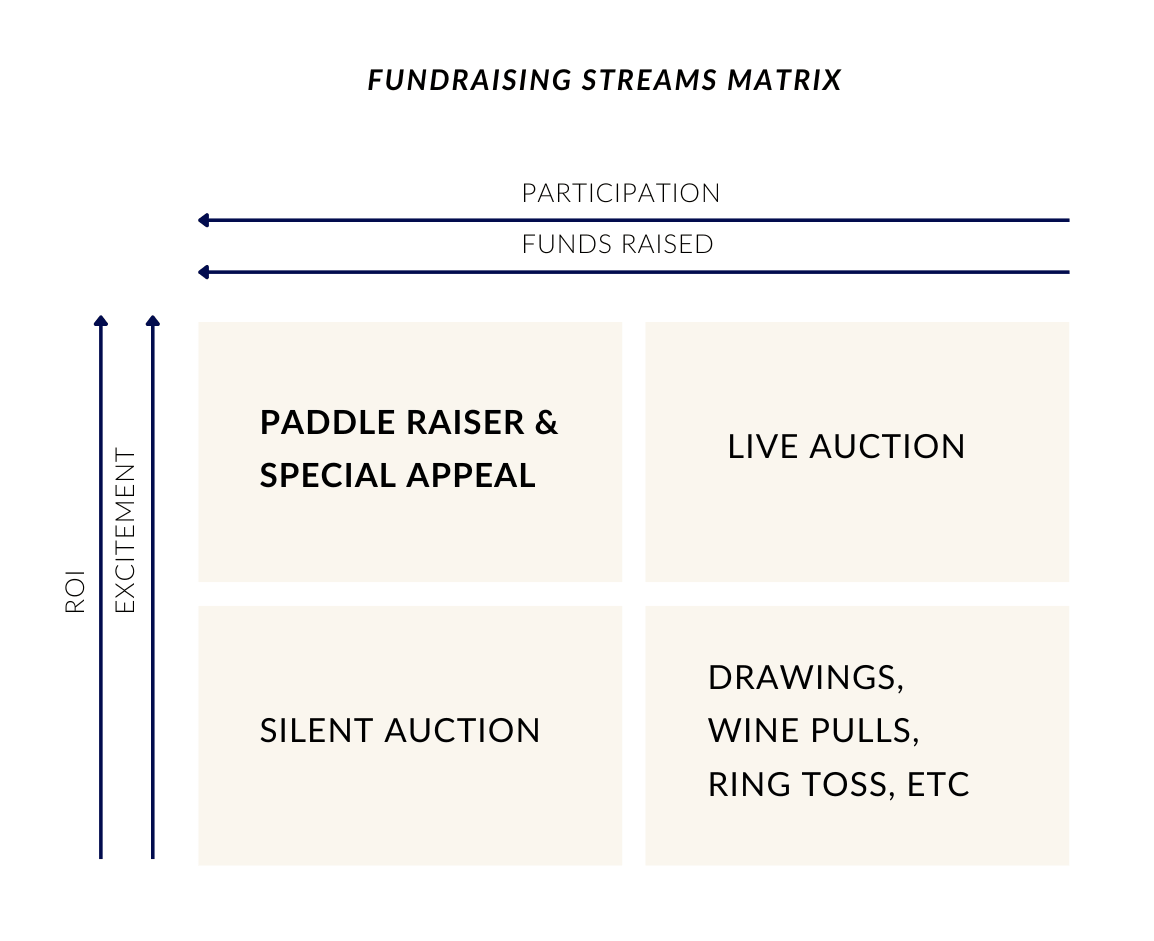
Whenever I'm working with a client, I like to step back and look at the entire fundraising strategy first.
That's exactly what the Fundraising Streams Matrix is designed to do. It helps you see where each fundraising stream fits and where your biggest opportunities are.
Everything points toward the paddle raiser.
That's typically where we see the highest participation, the largest gifts, the strongest return on investment, and some of the most memorable moments of the night.
There's nothing quite like watching card after card go into the air while the fundraising total climbs. It's exciting. It brings the entire room together around your mission.
It's also one of the highest-return uses of your team's time.
You could spend five hours collecting one more silent auction package that nets a couple hundred dollars.
Or you could spend those same five hours meeting with major donors, securing plants and matching gifts, and creating momentum that could generate thousands of dollars during your paddle raiser.
Maximize Your Biggest Opportunities First
The live auction is another high-impact fundraising stream. Participation is naturally lower because fewer guests are in a position to purchase those experiences, but the revenue and excitement can still be tremendous.
A silent auction can also perform very well, especially when it's open online before the event and to your broader supporter base.
Only after those pieces are strong do I start looking at additional fundraising activities.
Before adding another game or drawing, ask yourself:
- Is our paddle raiser as strong as it can be?
- Have we secured plants and matching gifts?
- Do we have a compelling mission story?
- Is our fundraising structure working as hard as it can?
If the answer is yes, then it's time to think about what additional opportunities make sense.
Ask Small, Get Small
One idea I talk about often is this:
Ask small, get small.
Imagine I walk into cocktail hour and spend $20 on a wine pull.
For some guests, that feels like their donation for the evening.
They've participated. They feel good about giving. And when the paddle raiser begins later, they may be less inclined to make another gift. And that $20 is their donation instead of the $50 or $100 that might be the lowest level of the paddle raiser.
That's why I encourage organizations to think strategically about their smallest ask.
Does that amount help move your overall fundraising goal forward?
Sometimes raising that entry point to $50 or $100 creates a much stronger fundraising opportunity while still feeling accessible to guests who want to participate.
Your supporters are there because they care about your mission. A thoughtful fundraising strategy helps guide that generosity toward gifts that have a bigger impact.
Look at the Return on Effort
The other thing I always think about is return on effort.
Take a wine wall, for example.
Let's say you collect 20 bottles and sell chances for $20 each. If every bottle sells, you've raised about $400.
Now think about everything it takes to make that happen.
Collecting the wine.
Wrapping the bottles.
Setting up the display.
Managing the activity during cocktail hour.
Tracking purchases.
Transporting everything.
Packing up what's left.
That's a lot of work tied to $400 in potential revenue.
Whenever I'm evaluating an activity, I'm asking whether that return justifies the amount of time and energy it requires from the team.
Could Those Same Items Raise More Somewhere Else?
Sometimes the answer isn't removing an activity. It's using those same donated items differently.
For example, instead of creating a wine wall, I might recommend collecting a few more bottles and building a wine cellar package for the live auction.
I
've seen wine cellars consistently outperform what those same bottles would have generated individually.
That same collection of donated wine could raise $1,500 or even $2,000 in the live auction instead of $400 during cocktail hour. (Plus you don't have to do the work to prepare a wine pull)
That doesn't mean a wine wall is never the right choice. It simply means it's worth asking whether there's another way those donated items could create even more impact.
Keep It Simple
Whatever fundraising activity you decide to include, keep it simple.
It should be easy for guests to understand, easy to participate in, and aligned with your overall fundraising strategy.
I also encourage organizations to be thoughtful about how many things are happening during cocktail hour.
Every fundraising activity is competing for your guests' attention.
The more mental energy guests spend figuring out games and drawings, the less focus they have when your paddle raiser begins.
The strongest galas I've seen don't have the most fundraising activities. They have the right fundraising activities.
Choose the ones that support your overall strategy, generate meaningful revenue, and are worth the time it takes to execute them.
That's how additional fundraising earns its place.
Check out this post to learn more about keeping fundraising games simple: The Fundraising Rule That Increases Participation