
When Do I Know If It?s Time to Raise My Ticket Price?
If you?re asking whether it?s time to raise your gala ticket price, there?s a very good chance the answer is yes.
This is one of the most common conversations I have with Executive Directors, Development Directors, and gala planners. Especially after an event sells out, the room feels full, and yet the fundraising results still don?t feel proportional to the amount of effort involved.
Because one of the most important things to understand is this:
Event turnout does not automatically equate to event payout.
Two Real Galas, Two Very Different Results
In this video, I compared two real events from 2024. We?ll call one the ?quantity gala? and the other the ?quality gala.?
The quantity gala believed:
- Lower ticket prices would free up donor money
- More people meant more fundraising
- More auction items meant more revenue
- A longer program added more value
So they charged $60 per ticket, had around 200 guests, built a large silent auction, and packed the evening full.
The quality gala took a different approach.
They believed:
- Higher ticket prices would attract donors with more giving capacity
- A curated event experience would perform better
- A boutique silent auction would create stronger bidding
- Plants and matches would drive the paddle raiser
- A leaner program would keep energy focused
They charged $125 per ticket and hosted about 100 guests.
And the results were fascinating.
The quantity gala raised about $17,765 through their live auction and paddle raiser, which worked out to roughly $88 per person.
The quality gala raised $23,300, or about $233 per person.
Half the guests. More than double the fundraising per attendee.
One of the main reasons is the ticket price was high-enough in the quality gala to bring in donors with a larger capacity.
Bigger Isn?t Always Better
One of the hidden benefits of a higher ticket price is that it can actually simplify the event.
The quality gala had:
- Fewer meal selections to manage
- Fewer guest logistics
- Lower catering costs
- Less event management complexity
- Less follow-up
- Less overall staff strain
That?s important because galas require an enormous amount of coordination and energy. If an organization can raise more money with fewer people and less logistical pressure, that creates a very different kind of return on investment.
Your Ticket Price Helps Set the Ceiling
This is where the Pure Profit Iceberg becomes really helpful.
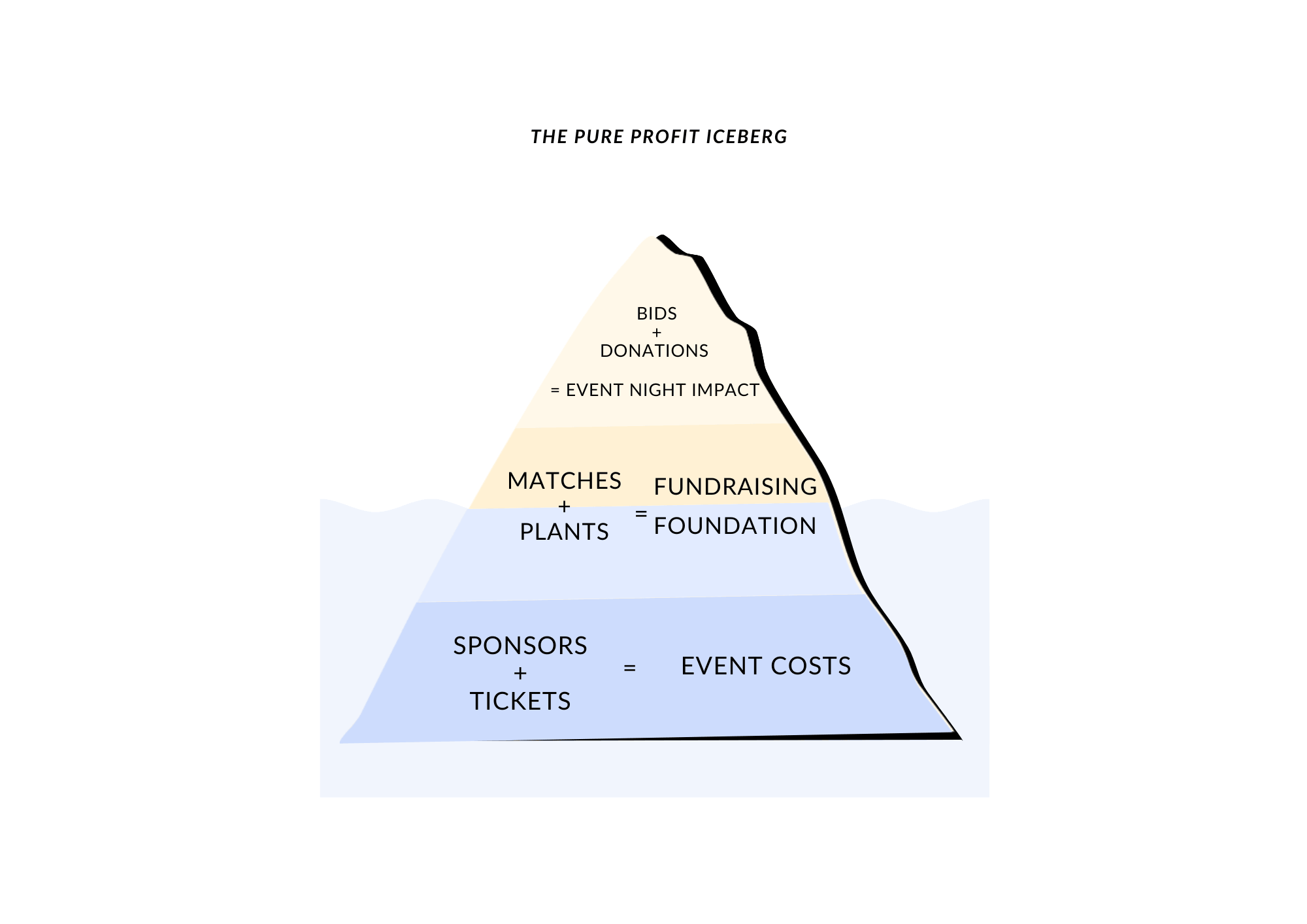
At the base of the iceberg, sponsors and tickets help cover event costs. Ideally, they more than cover them so the event can begin generating true fundraising profit.
That means your ticket price matters long before the paddle raiser even begins.
Then at the top of the iceberg is what I call event night impact:
- Auction bidding
- Paddle raise giving
- Donations
- Guest participation
A lot of this is influenced by who is in the room and what level of giving capacity they have.
Your ticket price quietly helps shape that.
Because when guests can comfortably afford a higher ticket price, there?s often more room for:
- Auction bidding
- Larger paddle raise gifts
- Sponsorship upgrades
- Additional giving throughout the evening
In many ways, your ticket price silently sets the ceiling for your event.
Signs It May Be Time to Raise Your Ticket Price
There are a few major clues that it may be time to increase pricing.
One is if your event is consistently selling out.
At that point, you typically have two options:
- Move to a larger venue
- Keep the same venue and gradually increase ticket pricing
In many cases, increasing the ticket price first is the simpler and more profitable move.
Another clue is if your turnout is high but your payout feels relatively low.
If you have a packed room, a huge silent auction, lots of activity, and yet the fundraising results still feel capped, that?s usually worth evaluating.
You also want to look at whether your fundraising streams are plateauing. If you?ve already maximized participation but revenue growth has stalled, ticket pricing may be part of the next strategic shift.
Fewer Guests Can Still Mean More Impact
One fear organizations often have is: ?What if we don't sell any many tickets??
Honestly, that may happen. But fewer guests does not automatically mean less fundraising.
In many cases, the opposite happens.
A more intentionally priced event can lead to:
- Stronger donor capacity in the room
- Higher giving participation
- Better auction performance
- Less logistical overwhelm
- More strategic fundraising outcomes overall
And importantly, there are still ways to maintain accessibility through layered ticketing, sponsorship access, hosted tables, and other creative strategies. Raising ticket prices does not have to mean leaving people behind.
Focus on Profitability, Not Just Attendance
One of the biggest shifts nonprofit leaders can make is moving from:
?How many people attended??
to:
?How profitable and sustainable was this event??
Because ultimately, the goal isn?t simply filling a ballroom.
The goal is creating an event that meaningfully supports the mission while still being worthwhile for your team to produce.
If you want help running the numbers for your own event, download the Goal Setting & Ticket Price Calculator. It?ll help you objectively assess your ticket pricing, sponsorship goals, and overall event profitability.