
Setting your gala fundraising goal can feel like a shot in the dark.
How do you know if it?s too high, too low, or actually realistic?
If you?re an Executive Director or Development Director trying to plan a profitable event, this is one of the most important decisions you?ll make.
When Goals Are Based on Hope
A couple of years ago, I stepped on stage for a fancy gala expecting paddles in the air at $20,000, $15,000, $10,000.
Seconds before I walked on stage, I found out those weren?t real donors. They were just hoping people would give at those levels.
That?s when I understood why I was uneasy all day. This was about to get awkward.
The goal had nearly doubled from the year before, but the work to support that increase hadn?t been done. They were guessing. Hoping past donors would show up and give again, without actually talking to them.
When your goal is unrealistic, everybody feels it. The room feels awkward. The team feels demoralized. And things are quiet when it should feel energized.
Goal setting isn?t just about math. It sets the emotional tone for the entire night.
Build Your Goal From the Bottom Up
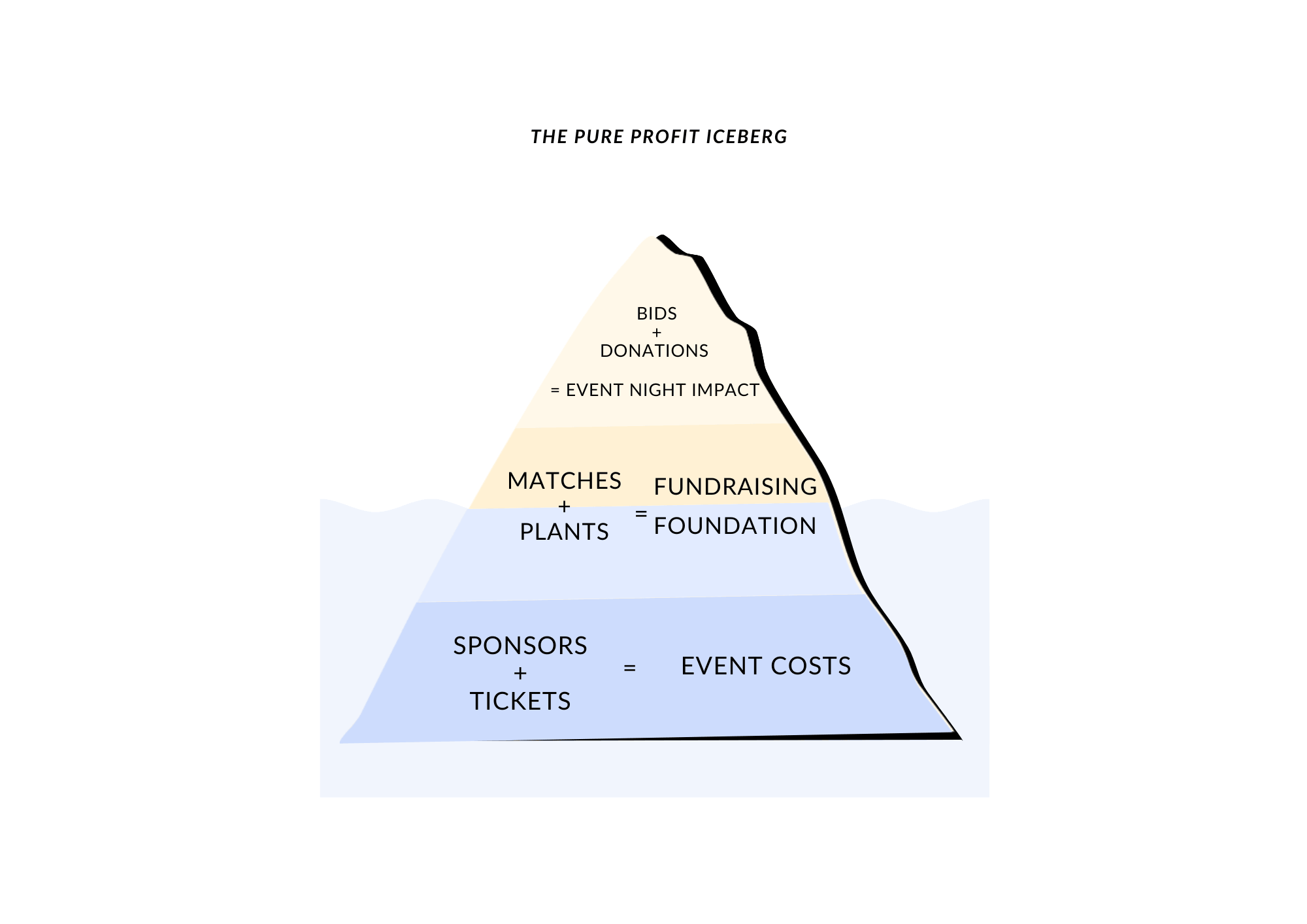
This is where the Pure Profit Iceberg becomes incredibly helpful.
It?s not just a visual. It?s a checklist for how to build a profitable gala from the ground up.
At the bottom, your sponsors and ticket revenue should cover your event costs. Ideally, they do more than cover them. This is what protects your event and allows everything else to be profit.
The middle layer is your fundraising foundation. This is your plants and your matches. These are pre-committed donors who you?ve actually talked to and confirmed are planning to give.
A good rule of thumb is to have about 50% of your paddle raiser goal accounted for through plants and matches. This is what creates stability and momentum in the room.
At the top is your event night impact. This is the most visible part, but it?s also the least predictable. These are the bids, the donations, the energy in the room.
A misconception is to rely on this part the most, when in reality, it?s the part we want to rely on the least.
When you build from the bottom up, the top of the iceberg can stick farther out of the water.
Don?t Just Add More to Last Year?s Numbers
One of the most common decisions I see is organizations taking last year?s results and just adding more.
That only works if you?ve confirmed your key donors are coming back and are willing to give again.
A better metric to look at is how much you raised per paddle last year. Then look for evidence to show that you can realistically meet or exceed that number this year.
That gives you a much clearer picture of whether your goal is grounded in reality or just wishful thinking.
Use Tools to Take the Guesswork Out
If you want to set a goal that actually works, you need to see how all the pieces fit together.
That?s why I created the Goal Setting and Ticket Price Calculator.
It helps you plug in your expenses and your fundraising goal, then breaks down what you need at each level of the iceberg. Sponsorship targets, number of plants, and whether your ticket price supports the kind of giving you?re expecting.
If your ticket price isn?t aligned, it will show you. And it will also show you how to offset that by strengthening your sponsorships or your fundraising foundation.
Bringing it all together
If your goal is based on hope, you?re setting yourself up for a tough night.
When your goal is built with intention, everything feels different in the room.
Download the Goal Setting and Ticket Price Calculator to map out your numbers and make sure your next gala is set up to succeed.