
You can have an AMAZING team planning your gala, but if people are playing the wrong positions, the process is going to be harder, and your fundraising results might not be nearly as strong as they could be.
One of the biggest mistakes I see nonprofits make is treating fundraising strategy and event planning like they're the same job.
They're not!
Both are incredibly important, but they require different skills, different priorities, and sometimes entirely different people.
That's why I LOVE using this sports analogy to help nonprofits think through their gala teams.
Offense is fundraising success. Defense is event planning success.
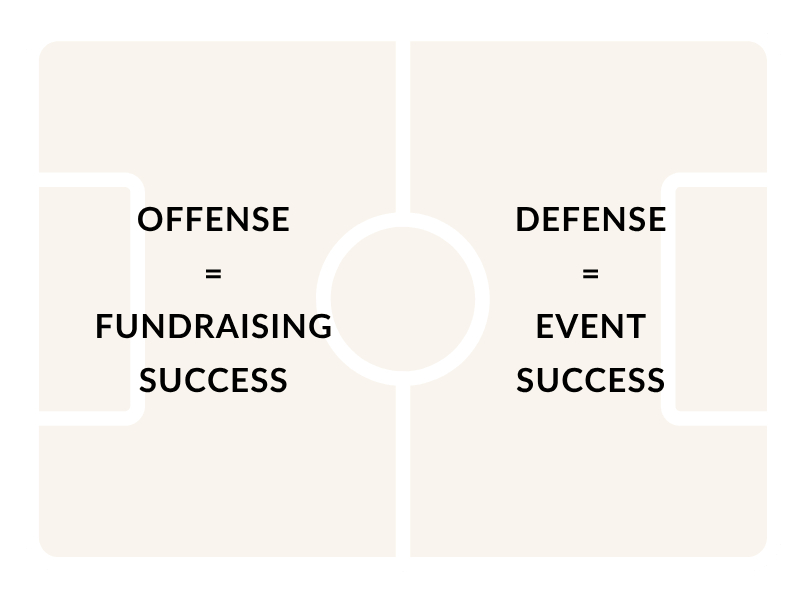
And just like any great sports team, you need BOTH to win.
But first, let me tell you a little story about my own coaching career.
The Time I Was a TERRIBLE Head Coach
I played Division I lacrosse in college, and when I graduated, I knew I wanted to coach.
And let me tell you, I LOVED it.
My players loved me, too!
I'd show up to the field, and they'd come running over, yelling, "Dani! Dani!"
They'd write me these adorable notes in rainbow-colored markers, telling me how much they loved lacrosse, how confident they felt, and how excited they were to come to practice.
Parents would stop me after games to tell me how much their daughters had grown. They'd write thank-you letters and give me little gifts because their kids were having such a wonderful experience.
And I thought, "WOW. I am absolutely CRUSHING IT as a coach!"
Except for one tiny detail.
We were losing. A LOT.
I'm talking something like 10 wins and 30 losses. I don't remember the exact record, but trust me, it wasn't pretty.
I was doing a fantastic job helping those girls build confidence, love the sport, and grow as people.
But when it came to actually WINNING games?
Not so much.
Looking back, I realized I probably would have made a much better assistant coach.
I was great at building relationships, encouraging players, and helping them develop.
But the head coach needed to be thinking about strategy, competition, and what it would take to win.
And that experience taught me something I've carried into my work with nonprofits ever since.
Sometimes you don't have the wrong people. You just have them in the wrong roles.
Your Gala Is Your Super Bowl
Think about how much time, money, and energy goes into planning your annual gala.
We're talking hundreds of hours of work, often 500 or more.
You've got sponsors to secure, donors to invite, auction items to collect, vendors to coordinate, volunteers to organize, and a million little details that all need to come together on ONE night.
That's why I like to call your gala your Super Bowl.
This is a BIG deal!
And if we're going to treat it like a championship game, we need to start thinking about how we're building our team.
There are two sides to your gala:
- Offense = Fundraising Success
- Defense = Event Planning Success
Both sides are working toward the same overall goal, but they're responsible for very different things.
Let's break it down.
Offense: The People Responsible for Fundraising Success
Your offensive team is focused on one primary question:
How are we going to raise the most money possible for our mission?
These are your fundraising brains, your relationship builders, your sales and marketing people, and the folks who understand what motivates donors to give.
They're thinking about revenue, ROI, sponsorships, donor capacity, and how to create a fundraising program that inspires people to give generously.
Here's what belongs on offense.
Sponsorships, Ticket Sales, and Audience Building
Who's coming to your gala matters just as much as how many people are coming.
Your offensive team is responsible for thinking strategically about your audience.
Who are we inviting? Who has the capacity and interest to give? Who should be hosting tables? How are we positioning sponsorship opportunities?
And who actually has the relationships to make those asks?
That last question is especially important.
I don't want your event planner spending hours trying to secure a sponsorship from someone they've never met when you have a board member who's been golfing with that person for 15 years.
Fundraising is relationship work.
Let's put the people who hold those relationships in charge of using them!
Live and Silent Auction Strategy
Your auction strategy is also offense.
And I don't just mean finding enough items to fill a table.
I'm talking about:
- Which live auction packages are going to appeal to your audience
- How many items you're selling
- How those packages are described and presented
- How you're pricing and displaying silent auction items
- Which items you should pursue in the first place
- How your auction fits into the overall fundraising strategy
All of those decisions can directly affect how much money you raise.
This is absolutely offensive work.
The Paddle Raise and Mission Moment
Your paddle raise is one of the biggest fundraising opportunities of the night.
That means your giving levels, impact anchors, storytelling, plants, matches, and overall paddle raise strategy all belong on offense.
Your mission moment video belongs here, too.
I always say, "Whiskey opens mouths. Stories open wallets."
A great mission video isn't just another piece of entertainment.
It's an opportunity to help guests connect emotionally with your mission and feel inspired to give.
That's fundraising!
Your Fundraising Program
Here's an important distinction.
The actual fundraising program is offense.
I'm talking about the order of your mission moment, speakers, live auction, paddle raise, and other fundraising activities.
How are we building momentum? How are we keeping guests engaged? How are we creating the emotional connection that inspires generosity?
That's different from the logistical run of show that includes vendor arrival times, load-in schedules, and phone numbers.
Both matter!
But they're two different jobs.
Your Auctioneer and AV Team
Your auctioneer isn't just another vendor, they belong on your offensive team.
And I promise this isn't just a shameless plug for myself!
Benefit auctioneers spend their time working in fundraising rooms, watching what works, what doesn't, and how audiences respond.
Depending on the auctioneer, we may work 20, 40, or even 70 fundraising events in a year.
That's a LOT of opportunities to learn what actually raises money.
Bring your auctioneer into your fundraising conversations EARLY!
And here's another vendor that belongs on offense: your AV team.
I know, I know. You're probably thinking, "Dani, isn't sound and lighting an event planning thing?"
Well, yes. But it's also a fundraising thing.
Because if your guests can't SEE what's happening, they can't bid.
If they can't HEAR your speakers, they can't connect with the mission.
And if they can't follow what's happening during your paddle raise, you're making it harder for them to give.
If they can't see and they can't hear, they can't bid. Period.
Your AV team has a direct impact on fundraising success, and they deserve a seat at the offensive table.
Defense: The People Responsible for Event Planning Success
Now, let's talk about defense!
These are the people who make sure the whole event actually WORKS.
And believe me, a great defensive team is worth its weight in gold.
These are your detail-oriented, organized, logistical masterminds.
The Type-A brains who know exactly when the caterer is arriving, where the extension cords are going, how many chairs fit at each table, and who's responsible for putting the signs out.
I LOVE these people.
Because while your offensive team is thinking about fundraising strategy, your defensive team is making sure the event itself runs beautifully.
What Belongs on Defense?
Your defensive team handles things like:
- Venue selection and coordination
- Catering and beverages
- Decorations, theme, and rentals
- Check-in and checkout
- Guest registration and seating logistics
- Parking, signage, and guest instructions
- Entertainment and vendor coordination
- Event timelines and operational details
- Making sure guests have a smooth, enjoyable experience
Essentially, they're responsible for everything that needs to happen to make your gala look, feel, and function like a great event.
And that's a HUGE job!
Let Your Event Planners Do What They Do Best
I've worked with some unbelievably talented event planners.
People who can walk into an empty ballroom and somehow turn it into the most beautiful, organized event you've ever seen.
They think of details I wouldn't even dream of.
And I LOVE working with them.
But here's where I see nonprofits get into trouble.
They hire an event planner and then expect that person to drive their fundraising strategy, too.
Or they have their event committee making decisions about auction packages, paddle raise levels, sponsorship strategy, and fundraising programming.
And suddenly the people who are brilliant at logistics are spending their time trying to make decisions about donor psychology and fundraising revenue.
That's not necessarily where their strengths are!
My recommendation is to let your event planners play defense, and defense only.
Now, that doesn't mean the two teams never overlap.
Of course they do!
For example, your offensive team might secure a $10,000 sponsorship.
Then your defensive team takes over the logistics of making sure that sponsor's logo is on the website, their table is reserved, and their benefits are fulfilled.
That's a beautiful partnership.
Offense secures the commitment. Defense makes sure it's executed.
Everyone gets to do what they're best at.
Every Team Needs a Head Coach
So now we've got our offense and our defense.
We've got fundraising leaders focused on revenue and event planners handling logistics.
But there's one more role we absolutely need.
The head coach!
This is the person who sees the entire picture and has the authority to make final decisions.
Maybe that's your Executive Director.
Maybe it's your Development Director.
In some organizations, it could be a Director of Events or another leader.
The title isn't the important part.
What matters is that someone is responsible for keeping the entire team aligned.
Because there WILL be moments when offense and defense have different priorities.
Maybe the fundraising team wants to add another auction package, but the event team is worried about the timeline.
Maybe the event committee wants to spend more on decor, but the fundraising team wants to protect the net revenue goal.
Maybe someone has a brilliant idea that sounds really fun but doesn't actually support what you're trying to accomplish.
Someone needs to be able to look at the whole picture and make the call.
That's your head coach.
And unlike my very unsuccessful lacrosse coaching career, we want this person thinking about the scoreboard!
Stop Making Everyone Decide Everything
Here's another HUGE opportunity I see for nonprofit gala teams.
We involve WAY too many people in decisions that don't actually require everyone's input.
Think about how much time can get eaten up in committee meetings.
Someone makes a suggestion. Someone else has a different idea. Three more people weigh in. Now we need another meeting.
And suddenly a decision that could have taken 15 minutes has taken three weeks.
Sound familiar?
This is why I love separating higher-level strategy from execution.
In The Profitable Gala Playbook, we work to make the big strategic decisions with the people who actually have the authority and expertise to make them.
Typically, that's your head coach, your fundraising chair, and your event chair.
Once those decisions are made, we delegate!
Your committee members can focus on doing the work instead of debating the strategy every time they meet.
And here's the best part.
Clear roles don't just make your gala more profitable. They make planning it a whole lot more enjoyable!
People know what they're responsible for.
They know who makes the final decisions.
They know where their expertise is most valuable.
And they can actually move forward without feeling like every little thing needs to become a group discussion.
Keep Your Fundraising Leaders Focused on Fundraising
This one is especially important for Executive Directors, Development Directors, and board members.
Your time is incredibly valuable.
And when you're planning a gala, there are approximately one MILLION things competing for it.
But I want you to think about where you can make the biggest impact.
Is it deciding what color the napkins should be?
Is it making sure the photo booth vendor has the correct load-in instructions?
Is it coordinating which volunteer is going to put out the centerpieces?
Probably not!
Your highest-value work is often on offense.
Building relationships.
Securing sponsors.
Finding great auction opportunities.
Identifying and cultivating donors.
Thinking strategically about your paddle raise and fundraising program.
These are the activities that can directly affect how much money your gala raises.
And if your fundraising leaders are spending all their time buried in logistics, who's actually focusing on the fundraising?
This is one of the reasons I often recommend hiring a great event planner.
Let someone who LOVES logistics manage the logistics.
That frees up your fundraising leaders to focus on the work that only they can do.
The Bottom Line: Put the Right People in the Right Positions
The people planning your gala are talented, smart, hardworking people.
And if you're reading this, I'm guessing you've got some pretty incredible people on your team.
The opportunity isn't necessarily to find better people.
It's to make sure they're playing the right positions.
Remember:
Offense = Fundraising Success
Your fundraising strategy, sponsorships, audience building, auction strategy, paddle raise, mission moment, and fundraising program.
Defense = Event Planning Success
Your venue, catering, decor, logistics, registration, vendors, and overall guest experience.
Head Coach = Leadership and Decision-Making
The person who keeps both sides aligned and makes the final call when needed.
A great gala needs ALL THREE.
And when you put people where their strengths belong, you make the entire process easier, more enjoyable, and ultimately more profitable.
Because your gala isn't just a party.
It's one of your organization's biggest fundraising opportunities of the year.