
This might sound surprising coming from a benefit auctioneer. But not every gala should have a live auction. I get asked this question all the time: Is it okay if our event doesn?t have one? In many cases, the answer is yes.
Live auctions are often treated as a standard part of gala fundraising. When people picture a fundraising event, they naturally imagine an auction happening on stage. But just like every other decision in gala planning, whether or not to include a live auction should be intentional and strategic. Let?s walk through how to think about that decision.
Start With the Fundraising Streams Matrix
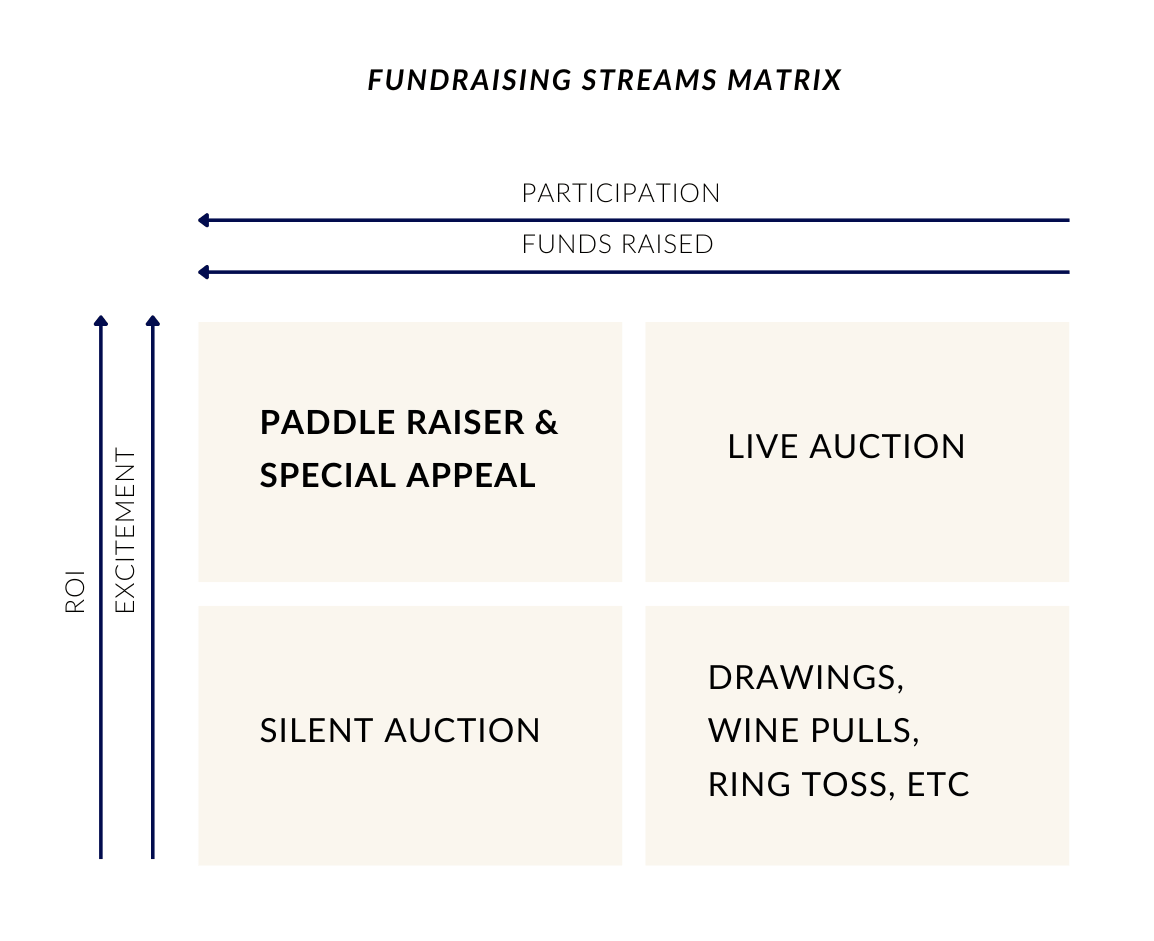
When evaluating fundraising streams, I like to start with what I call the Fundraising Streams Matrix. This framework helps nonprofit leaders prioritize the activities that create the most impact. At the center of the matrix is the paddle raiser, sometimes called the special appeal.
Across several key factors, the paddle raiser consistently ranks highest:
- It raises the most money
- It has the highest return on investment
- It generates the most excitement in the room
- And it allows everyone in the audience to participate
Because of that, the first question you should ask is not whether you should add a live auction.
Instead, ask:
- Have we fully maximized our paddle raiser?
- Have we cultivated donors who can serve as plants or matches?
- Have we created a powerful mission moment that connects emotionally with the audience?
- Have we built momentum around this giving moment?
If the answer is no, that is where your focus should be.
In many cases, investing more energy into strengthening the paddle raiser will produce far more revenue than adding additional fundraising streams.
Does the Math Actually Work?
If your paddle raiser is already performing well, the next step is to look at the numbers.
A useful rule of thumb is that roughly 10 percent of your audience has the financial capacity to win a live auction package.
Let?s say you have 100 people at your event. Ten percent of that audience is about ten potential bidders. (There are of course some outliers, but this is a general starting place to think intentionally)
But since many guests attend as couples, that number quickly shrinks to roughly five to seven bidder paddles in the room. Each live auction package typically needs three to four bidders to create a true bidding competition.
If you only have five or six bidders available, the math simply may not support a strong live auction. In that case, you might only be able to run two or three packages effectively. Once your event grows to 200 or 300 attendees, the bidder pool expands and the math starts to make more sense.
Your Ticket Price Matters
Another important factor is your individual ticket price, because it signals the overall resource capacity of the audience in the room.
Ticket price helps predict what your auction packages might realistically sell for.
As a rough guideline:
- Ticket prices below $100 often produce auction bids in the high hundreds.
- Ticket prices between $100 and $200 often produce bids in the low to mid thousands.
- Ticket prices above $200 can support mid to higher thousand-dollar bids.
These are not exact rules, but they help set expectations. Your audience?s giving capacity ultimately determines whether a live auction can produce meaningful revenue.
Consider the Time Investment
A live auction also requires time during the program. Each package typically takes three to four minutes to auction off. If you include five packages, that could add roughly twenty minutes to your program.
That time has to be worth it financially because the rest of your audience is waiting for the live auction to be over.
If your live auction packages are only selling for only hundreds of dollars each, it becomes difficult to justify that much program time. In contrast, paddle raisers often generate thousands of dollars per minute.
So before adding a live auction, ask yourself whether the potential revenue supports the time investment.
A Real Example of Adding a Live Auction Later
One of my nonprofit clients is a great example of how this decision can evolve over time.
For the first three years of their gala, we didn?t include a live auction at all. Instead, we focused entirely on strengthening their paddle raiser and a small boutique silent auction. Each year we improved the paddle raiser strategy. We added matches and plants, refined the mission moment, and created stronger emotional connection with the audience.
After a few years, the paddle raiser had become extremely strong. At that point, both the audience energy and the donor feedback made it clear that the room was ready for something more. We added a small live auction with three packages, eventually expanding to five.
Today, their paddle raiser raises about $75,000, while the live auction adds another $10,000 to $15,000. The live auction works because it adds both energy and additional revenue without taking away from the core fundraising moment. (We could have probably added a live auction a year sooner too I think)
The Live Auction Should Add Energy
The final test is simple. A live auction should add energy to the room, not drain it.
When the right audience, packages, and pacing are in place, the live auction can become a fun and exciting part of the evening.
But when the room isn?t ready for it, the program can start to feel long and exhausting. Most guests can?t participate in the bidding, and the momentum of the evening can stall. That?s why the decision to include a live auction should always be intentional.
Bringing It All Together
Not every gala needs a live auction. Start by focusing on the most powerful fundraising stream you have: the paddle raiser. Make sure that moment is fully developed and performing well.
Then consider whether the math supports a live auction. Look at your audience size, ticket price, and the time available in your program. Finally, ask whether the live auction will truly add excitement and energy to the room.
When those pieces align, a live auction can be a fantastic addition. But when they don?t, focusing on your on a paddle raiser will lead to a more profitable and effective event.