If your board members aren?t helping with your gala, this video will help you explore one of the most common reasons and what you can do about it.
This training is for Executive Directors and Development Directors who feel stuck carrying the fundraising load alone.
You?ll learn how to give your board the clarity, structure, and direction they need to meaningfully support your gala.
In this video, you?ll learn how to:
You?ll also hear a real example from an event Dani did, where a board that claimed it wasn?t a fundraising board generated over $10,000 in impact through clear goals, paddle raiser plants, and unique auction packages.
If you want more practical, strategy-first guidance on running profitable galas, I share additional tools and insights in my newsletter.
Subscribe here:
[Insert newsletter link]
We?d love to hear from you in the comments. What?s one positive example of how a board member has supported your gala, or what?s been most challenging about board engagement for you?
Hey, I'm Danny Dar Rosa and I help
nonprofit leaders crush their annual
gallas by having the right strategy.
Over the years as a benefit auctioneer
and a gala fundraising consultant, I've
helped raise over $50 million at over
400 gallas and I have learned a thing or
two about working with your board.
Let me start off by telling you about a
client that I worked with recently who
told me in our meetings that their board
does not help with the gala. We don't
have a fundraising board. They never
help us with the gala. Sometimes they'll
buy a table. They'll bring some people
here and there, but for the most part,
they are not a fundraising board. Now,
with all of my years of experience, when
I hear that, the first thing I'm really
curious about is whether or not the
board actually knows what it means to be
a fundraising board. So in this case, I
asked to go to one of their board
meetings and present on a few topics
to educate the board a little bit as to
their potential role in the gala, how
some of these goals break down, so on
and so forth. So I go to the board
meeting, I share with them what it looks
like to make an event profitable, what
the different fundraising streams are,
and exactly how they could end up
supporting. Now, after giving them some
ideas of how they could help support the
paddle raiser as well as the live
auction, what ended up happening was
this board that apparently is not a
fundraising board and apparently never
helps with the gala. They ended up
collectively raising $8,500
in in plants. So, they were plants for
the paddle raiser. $8,500 worth. Of
course, they bought tables like they
usually do. And we also got two really
unique live auction items out of um you
know their donations that ended up
raising us thousands of dollars in the
live auction as well. So over $10,000
came from their board. This was at the
final hour also probably only like six
to eight weeks before the gala. But we
were able to get over $10,000
in impact at their gala that year just
from having these conversations. Now
what did we talk about? Now the thing to
remember is that your board members are
completely committed to the success of
your organization and your gala or they
wouldn't be your board members. Now one
of the common reasons why they're not
engaging, you know, not only with your
gala but probably a lot of other aspects
of helping run the nonprofit is because
of ami ambiguity. A lot of times we, you
know, tell our board members, you need
to get us sponsors. you need to get us
donors. You need to bring good items.
But unless we actually break down the
goals and make things specific, any busy
adult has a really hard time following
through because remember we have our own
jobs, we have our families, we have our
grievances, we have our trauma, we have
our drama, we have different things that
come up in our life that make it really
difficult for us also to follow through
on really ambiguous asks.
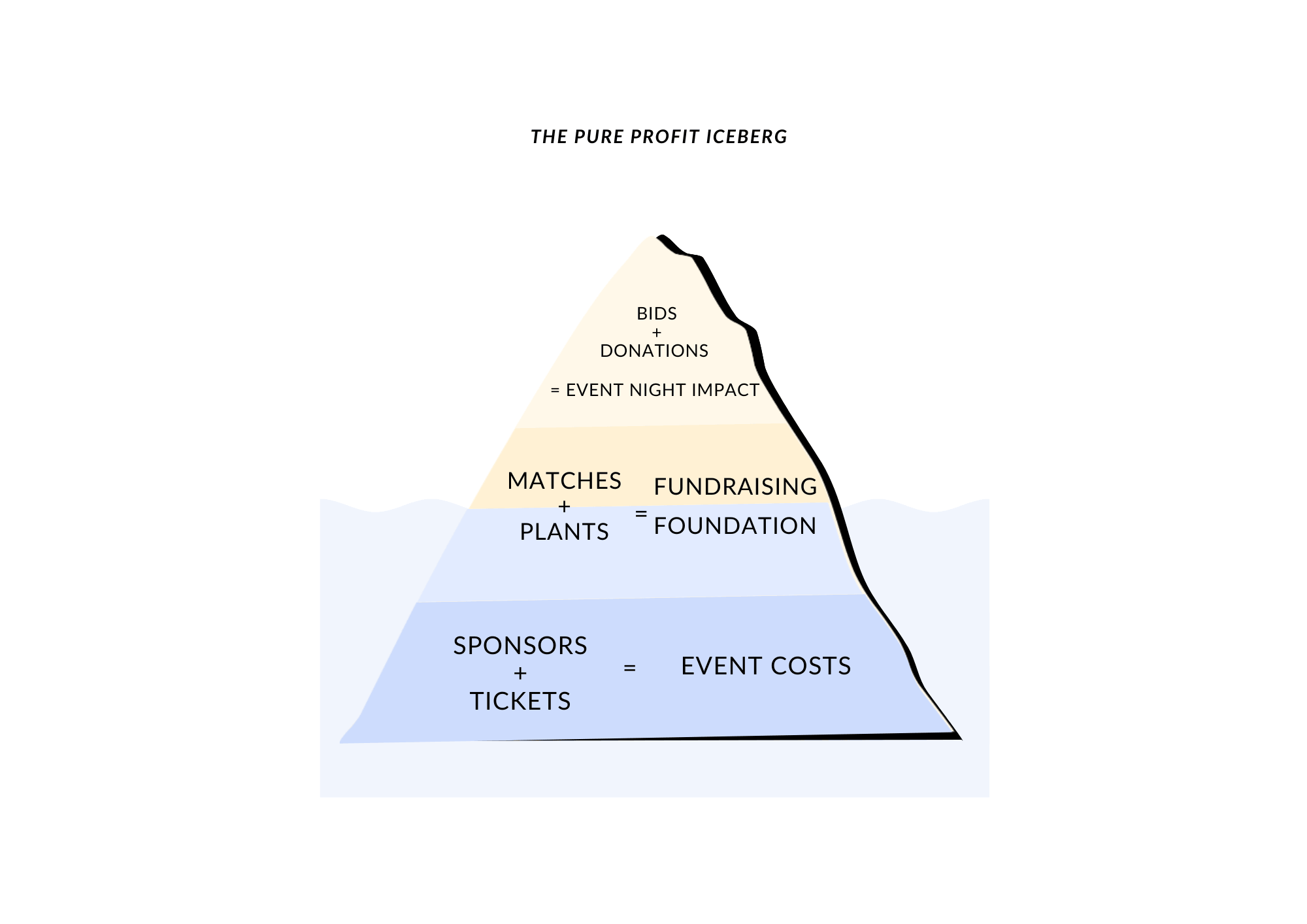
Now, the first thing I like to do when I
go to a board meeting is show them the
pure profit iceberg. Now, the iceberg
here, I talk about it in a lot of my
videos because it is the foundation of
creating a really profitable fundraising
strategy. When we look at the iceberg,
half of it's under the water, half of
it's above the water. The very bottom
part, we learn that sponsors and tickets
should more than cover event costs.
Okay, so this is the first level where
we can show the board how this becomes
profitable. The next part, the middle is
the fundraising foundation. It is
halfway underneath the water and halfway
above because our donors and our guests
don't see us cultivating it, but they do
feel the impact at the event. Now, your
fundraising foundation is made up of
matches and plants. A match is somebody
who offers a challenge to the audience.
They say, "I'm willing to donate $10,000
for every dollar raised up to $10,000."
A mat, a plant, excuse me, a plant is
somebody who is planted in your audience
and ready to raise their paddle for a
certain level in the paddle razor. They
say, "I'm going to raise at 2500. I'm
going to raise at 5,000." So on and so
forth. Now, this middle part is a huge
area that our board members can support.
Not only can they be matches and u
plants potentially, but if they were
able to help cultivate some plants and
matches, this is going to help make the
paddle raiser really successful. The
very tip of these this iceberg is the
event night impact. This is the bids and
the donations. So all the bids on the
live auction and the silent auction, all
the donations in the paddle raiser. This
part is a little bit out of our control,
but the part that makes it in our
control is that we need to have a high
enough ticket price to bring in donors
and guests with enough resource capacity
to make big donations and bid high on
our auctions. And then we also need to
get the right items, the right number of
items, things people actually want to
bid on. We need a program that has a
really great mission video, a program
that's not too long, that doesn't make
them feel bored or restless in their
seats, and we need a great professional
auctioneer. So, there are a few things
that come into place there. But the
first thing I do when I go to a board
meeting is I show them the levels of the
iceberg so they can understand at a high
level how we're going to make this
profitable. And they start to think
about where they can fit in.
The next thing to do after showing them
this high level of how a gala breaks
down is to really understand
what are everybody's strengths. What are
we naturally drawn toward and where are
we most called to support? You know, so
just as an example, you know, if we have
some board members that are business
owners or they're sales managers or
maybe real estate agents, then they
really might understand the sales and
marketing side of things. it might be
easier for them to then try to get some
sponsors on board. Maybe you can give
them a list of potential sponsors and
they can be the ones that reach out to
them and they try to secure, you know,
some sponsors and, you know, more on
that is in one of our previous videos in
terms of how many sponsors you want to
go after. So maybe a board member is
really drawn toward that or maybe we
have a board member that is a lot more
analytical, um, focuses more on
logistics and details. Maybe they're
always poking holes in the budget. Maybe
they're really focused on cost versus
investment versus ROI. Well, that type
of mind is going to do a really good job
maybe on some of your event planning
details. Or maybe they're on the auction
committee where they're really going to
help um write the descriptions for the
packages, make sure all the details are
in them, make sure all the pricing info
is correct after we've set, you know,
some of those best practices. So, you
really need to start to break down the
strengths of your board. Um, we need to
understand which ones of them have
connection, which ones have connections
with hotels, with restaurants, with
private chefs. Um, maybe some of them
have private houses in the mountains, on
the beach. Um, connections to people
with some of these private houses.
That's kind of the next piece to this is
we really need to understand what are
they feeling energized about? what is
the lowhanging fruit in their life that
they can, you know, help with for the
gala. And we want to start putting those
pieces together.
Now, after all of this, you really want
to set some clear goals and expectations
for your board. People need to know
where the finish line is. If they're
going to participate in something,
they're going to feel good about it, and
they're going to really run as quickly
as they can forward. So, what this looks
like is, you know, after you determine
some of the strengths of your board
members, it's that, hey, if each one of
you can bring $5,000
and paddle raiser plants and matches or
sponsors, we are going to be able to
reach our goal of our the sponsors we
need and our fundraising foundation or
hey, if you know the two of you that are
really excited about sponsors, if you
can each secure $20,000 in sponsors, one
at the 10, one at the five, one at the
25, 500 and here's your sponsorship
package. Um, if you could secure that,
that would be helpful. Those of you who
are really excited to get live auction
items. We're looking for five unique
packages. Here's the categories of them.
This is how big we want the packages to
be. And by the way, in another video, we
will go through an acronym that really
helps you understand the different
categories of live auction items that
perform really well. But anyway, you
want to give the board members really
clear goals and a finish line so that
they understand exactly what they're
working toward and they know when to
give themselves a pat on the back that
says, "I did it. I'm done. I've
completed this."
So, to summarize, don't assume that your
board members are lazy. Don't assume
they're not a fundraising board. Don't
assume they don't want to help. What we
want to do is we want to give them the
right information, help them understand
the overall strategy and where they fit
in. We want to understand where their
strengths are, where the lowhanging
fruit is in their life that they can
easily get to come help bring resources
to the gala and we want to set really
clear goals and expectations for them as
to how they can support. Now, this does
take time to put this plan together, but
if you don't take the time to put a plan
together like this, you can't delegate.
You can't expect them to be able to just
read your mind. You can't expect them to
be able to go out there and make magic
happen. It's really important that we
have a really clear plan set in place
with deadlines, expectations, and goals
for each person.
If you've enjoyed this video, we have
more for you. Click the link below in
the description to subscribe to our
newsletter and we'll send them right to
your inbox. And then I'm curious if you
can comment below. Tell me about one of
the most unique ways a board member has
supported your gala. Maybe like a really
cool package that they got you or a way
that they brought some high- netw worth
donors. What is a really positive
experience you've had working with a
board member and how they supported for
a gala? And also we would love to hear
maybe what some of your challenges are
with getting board members to help with
your gala.
As always, we hope that your next event
is the most profitable one yet.