
If your board wants a silent auction but your team is already stretched thin, this can be a tricky situation. I see it all the time.
A nonprofit team quietly wonders if the silent auction is really worth the effort. Meanwhile, the board insists it should be part of the event because it feels like something a gala is supposed to have. Or because donors seem to like them
The challenge is figuring out whether a silent auction is truly the right move for your event?or whether it?s simply tradition.
Let?s walk through how to think about that decision.
The ?Two-Person Job? Lesson
A few years ago, my husband went out of town for the weekend and I decided it was the perfect opportunity to tackle a home improvement project.
I had exactly 36 hours to replace our kitchen backsplash before he got home.
But before I could start, I had to remove the large microwave mounted under the cabinet. When I looked up the instructions, every source stated that removing the microwave was a two-person job.
Naturally, I wouldn't be deterred so I decided to figure out how to make it a one-person job.
My plan looked something like this:
- Flip two five-gallon Home Depot buckets upside down
- Stack some 2×4s on top of them
- Leave two inches of space between the boards and the microwave
- Unscrew the mounting screws until the microwave gently dropped onto the boards
- Then grab it and carry it away
At first, everything worked perfectly. The microwave dropped exactly where I expected.
Then one of the boards popped loose and snapped upward?missing my face by inches. In that moment, I froze and thought: "wow...that was close". Followed by, "I guess it really was a two-person job".
Silent Auctions Are the Same Way
On paper, a silent auction often looks manageable. It looks like something you can ?just add.?
But the reality is that a silent auction is not a one-person job?and it is rarely even a two-person job.
It is a multi-person operation that involves many layers of work, including:
- Procuring items and experiences
- Designing the packages
- Writing descriptions and collecting photos
- Entering everything into a bidding platform or setting up the paper system
- Pricing the packages correctly
- Physically setting up the display
- Running checkout
- Managing packages that aren?t taken home that night
- And the list goes on...
When you add all of those pieces together, the silent auction becomes a significant time commitment.
That?s why the real question isn?t just whether your board wants one.
The question is whether the silent auction earns its place in your fundraising strategy.
Step One: Look at the Fundraising Streams Matrix
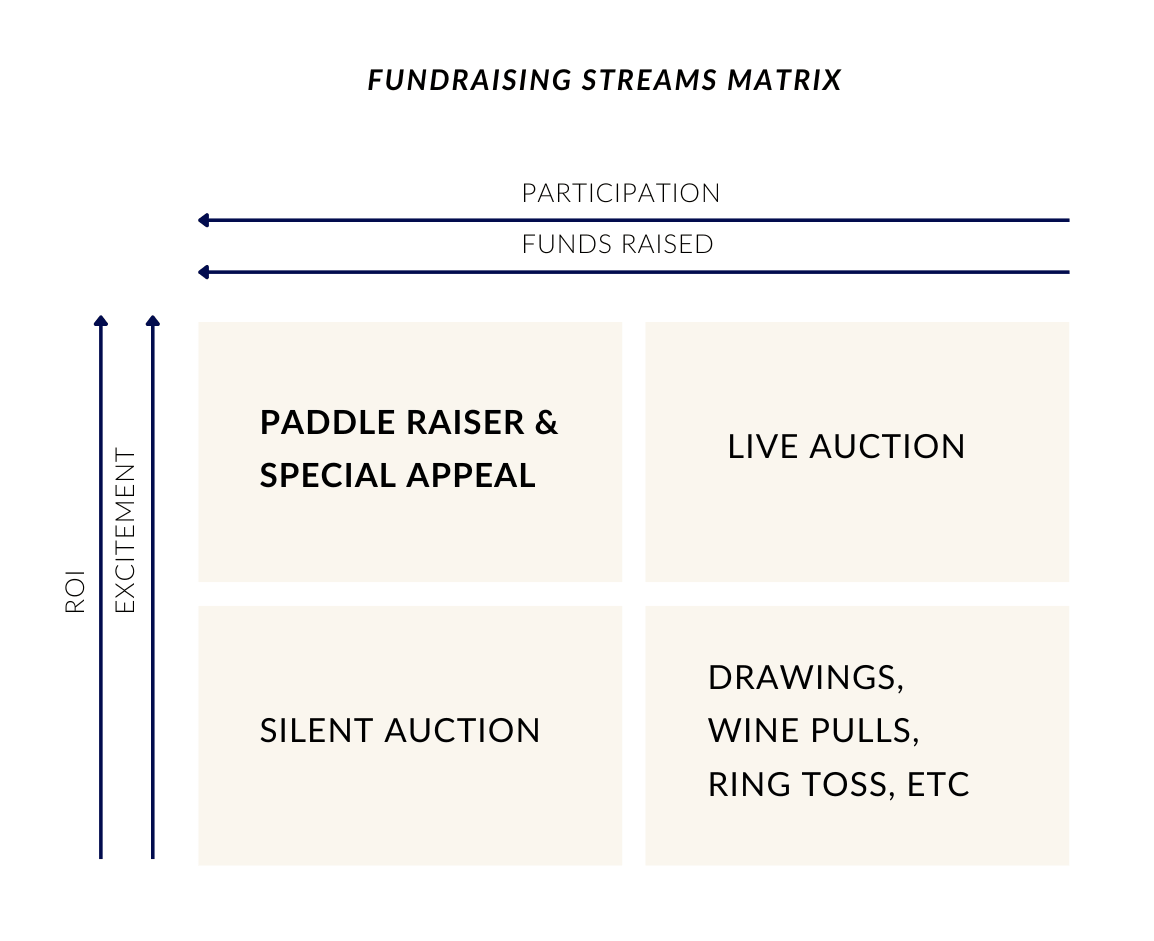
The first place to start is the Fundraising Streams Matrix, which ranks fundraising streams based on excitement, funds raised, and return on investment.
At the top of that matrix is the paddle raiser.
Before you consider adding or expanding a silent auction, you should first make sure you?ve fully maximized your paddle raiser.
That means asking questions like:
- Do we have a powerful mission moment that leads into the ask?
- Are there plants and matches in the room to create momentum? Have we maximized this?
- Do we have a professional auctioneer leading the paddle raiser?
If the paddle raiser still has room to improve, that is almost always where your time should go first.
After the paddle raiser comes the live auction, which typically produces a higher return on investment than a silent auction.
Only after those two areas are performing well does it make sense to evaluate whether a silent auction should be added. This framework can also help you have a productive conversation with your board about where effort and energy should be focused.
Step Two: Evaluate Your Team?s Capacity
Once you know it?s the right time strategically, the next question is whether your team actually has the capacity to run a silent auction.
Remember, this is a multi-person job.
If one person ends up carrying the entire silent auction, that individual may spend the majority of their time chasing down donations, collecting details, building packages, and entering data.
Organizations with large volunteer bases often manage this more easily. Schools, for example, frequently have parents who can contribute items like bottles of wine, gift cards, or parent-hosted parties. But smaller nonprofit teams often struggle because they simply don?t have the people power to manage all the moving parts.
And that?s where opportunity cost becomes important.
Consider the Opportunity Cost
Imagine spending five hours on silent auction tasks.
That time might include filling out donation forms, sending follow-up emails, tracking down photos, and assembling packages.
At the end of those five hours, you might generate $200.
Now imagine spending those same five hours meeting with potential sponsors or cultivating high-capacity donors who could serve as plants or matches in your paddle raiser.
Those conversations might generate $5,000, $10,000, $15,000, or even $20,000.
When time is limited?and it almost always is?it?s important to focus your energy on the activities that produce the greatest return.
Step Three: Do the Math
If the board still wants a silent auction after these conversations, the next step is to simply run the numbers.
Estimate:
- The total revenue the silent auction might generate
- The number of hours required to create and manage it
- The cost of mobile bidding software or other tools
Once you break down the math, it becomes much easier to evaluate whether the return justifies the effort. Sometimes seeing the numbers clearly is the most helpful way for a board to understand the trade-offs.
If You Do It, Make It Boutique
If the silent auction still makes sense?or the board strongly wants one?the best approach is often to keep it small and curated.
Think of it as a boutique silent auction rather than a large collection of random items. When there are too many packages, the auction can start to feel like a garage sale. That ?bargain hunting? mindset often leads to lower bids and weaker results.
Instead, focus on fewer packages with higher appeal.
Choose items that donors will genuinely be excited to win and take home. When the packages are thoughtfully curated and well presented, bidders are more likely to meet or exceed fair market value.
The goal is to create boutique energy, not flea market energy.
Bringing It All Together
Silent auctions can absolutely play a role in a successful gala.
But they should never be included simply because ?that?s what galas do.? Instead, they should earn their place.
Start by making sure your paddle raiser and live auction are performing as strongly as possible.
Evaluate whether your team has the capacity to run a silent auction well. And run the numbers to understand the return on the time invested.
If you do include one, keep it small, curated, and intentional.
Because the goal is not just to add more activities to your event. The goal is to make sure every piece of your gala supports your ultimate objective: raising as much money as possible for your mission.