
Disengaged and chatty donors are usually not a people problem. They are a program problem.
This is one of the most important mindset shifts nonprofit leaders can make when planning a gala. If donors are restless, distracted, or talking through key moments, the answer is not usually that they are rude or uncaring. More often, the program simply was not designed to hold their attention.
This is the second part of the conversation about donor attention. In Part 1, we looked at event planning fixes like sound, food, bar timing, and room layout. Those logistics matter. But once those pieces are in place, the next question is this: How do you actually create a program people want to pay attention to?
A Painful Gala Program
A couple years ago, I worked a gala with a program that went something like this:
It opened with two energetic local radio personalities serving as emcees. They talked for a while about the organization, their connection to it, and a little about themselves.
Then one of the top sponsors came up and spoke for about five minutes.
Then the CEO took the stage and talked for fifteen minutes about everything the organization had done that year, all while reading from a piece of paper and barely looking up.
Then there were a few more speakers.
Then the emcees came back.
Then I was introduced to run the live auction, which included nearly seven packages and took over twenty minutes.
Then we moved into the mission moment, which was a beautiful interview with someone served by the organization, but it lasted another fifteen minutes.
Then came the paddle raiser.
And after that, they handed out three or four awards.
It was a very long program.
In the debrief, the client was shocked that some of their top donors at the front table had talked during the CEO?s fifteen-minute speech.
But honestly, after hearing that whole sequence, the better question is: How could they not?
Org-Centric Programs vs. Donor-Centric Programs
That type of program is what I would call org-centric.
Org-centric programs are packed and painful. Donor-centric programs are targeted and impactful.
That distinction matters. An org-centric program is built around everything the organization wants to say. A donor-centric program is built around what the donor needs to hear, understand, and feel in order to give generously. Let?s look at the difference.
What an Org-Centric Program Looks Like
Org-centric programs usually have a few predictable characteristics.
- They try to speak to everyone, which means they are often focused on no one in particular.
- There is no clear target donor in mind, so the content becomes broad, crowded, and heavy.
- They create cognitive overload.
- The organization has context for every statistic, initiative, partnership, and update. But the donor does not. So when all of that information gets dumped into one program, it becomes too much to process.
- These programs also tend to include too much doom and gloom.
- They spend a long time emphasizing the problem without giving donors a clear sense of hope, progress, or momentum.
- Another issue is high-level jargon and overly polished language.
- If the message sounds elegant but does not deepen understanding, it's not helping.
- Org-centric programs also tend to feature too many talking heads.
- Sponsors, staff leaders, board members, and community partners are all be important to the organization, but on the stage isn't when your donors want to hear from them.
- And finally, org-centric programs often end with an ambiguous ask.
- The donor is not given a clear reason to act, a clear amount to consider, or a clear sense of what their money will do.
What a Donor-Centric Program Looks Like
A donor-centric program is different.
- It is designed for a specific donor, with a clear sense of what that person needs to think, hear, and feel in order to understand the mission and want to support it.
- That means it has cognitive simplicity.
- The content is trimmed down to the essentials. Visuals are used to increase understanding instead of adding more words.
- It shares a compelling vision.
- The donor hears not only about the problem, but about what is possible.
- It uses relevant stats and facts, not every available stat and fact.
- It relies heavily on storytelling, because stories are what people remember.
- It features the celebrities of the organization: the people or animals being served, and the staff members closest to that mission.
- It gives donors clear impact anchors, so the ask is concrete and easy to understand.
- And it closes the loop by helping donors understand what last year?s gifts accomplished and what we raised at this year's event.
Here's the goal: Design for donors, not for staff.
Your Donors Have Limited Attention
This is the part many organizations might not consider fully.
Your donors may love your mission. They may care deeply. They may be generous, loyal, and well-intentioned. But they are still tired.
Many of them came to your event after a full workday. They may have been up since early morning. They may have spent the day solving problems, answering emails, taking care of children, helping aging parents, walking the dog, and trying to keep life moving.
Even if it's a weekend night, by the time they arrive at your gala, they already have a lot on their minds.
So when the program is long, complicated, or overloaded with information, it becomes almost impossible for them to stay engaged.
That's why shorter and clearer beats longer and louder every time.
Use the Roller Coaster Framework
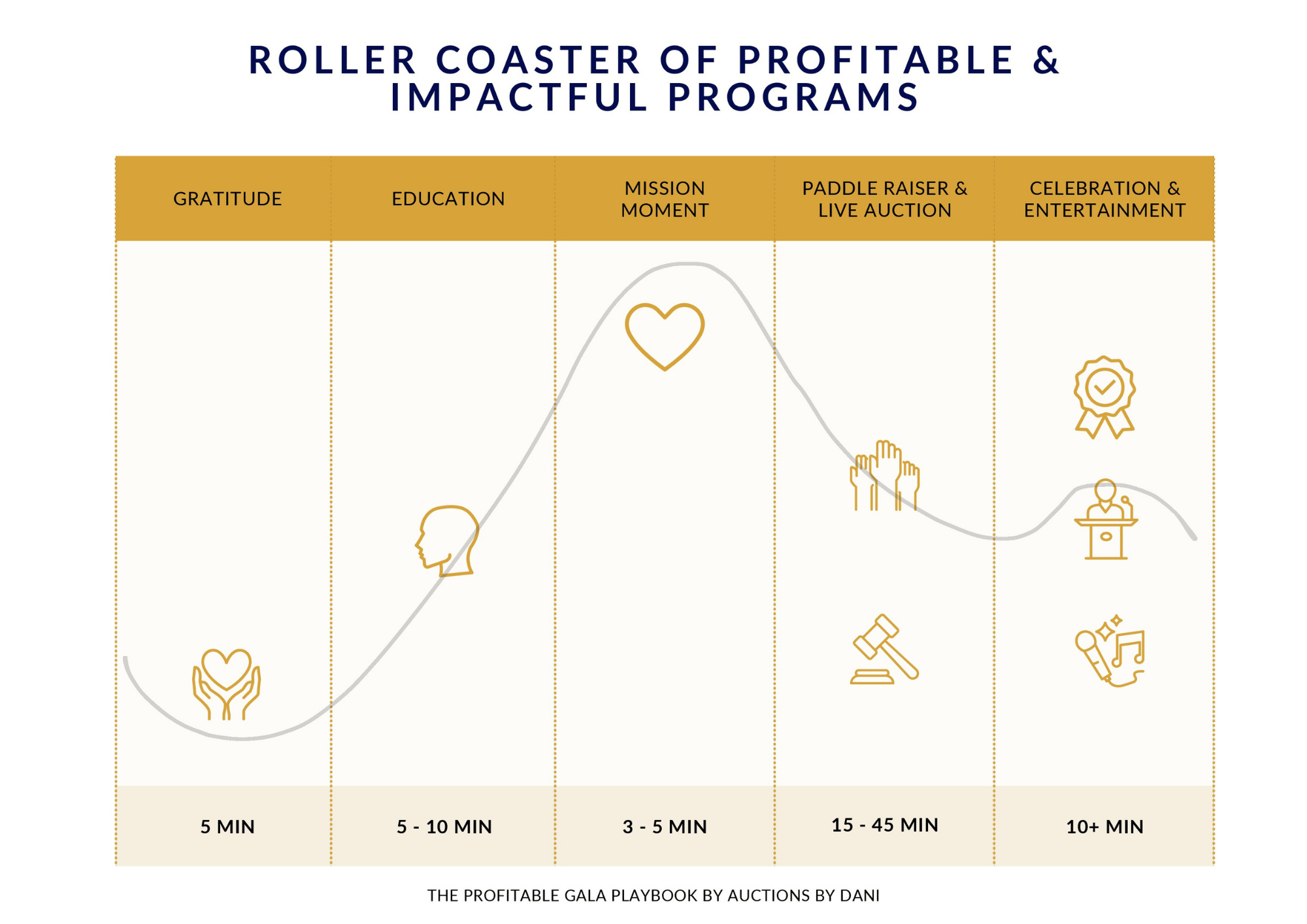
One of the best ways to build a captivating program is to think of it like a roller coaster.
As soon as the program begins, your donors are strapped in. They are going on a ride. Your job is to design that ride thoughtfully.
A strong gala program moves through five phases:
1. Gratitude
This is where the ride begins. Open with sincere, brief gratitude. Thank sponsors, guests, board members, or key supporters. This grounds the room and sets the tone. Keep it warm and genuine, but do not linger too long.
2. Mind
As the roller coaster starts climbing, this is the moment for the head. This is where you share the essential stats, facts, and vision. Talk about the problem your organization solves, the unique way you solve it, and the high-level picture of your work. This is the moment for clarity, not overload. A simple infographic or strong visual can often do more than several extra minutes of talking.
3. Heart
At the very top of the roller coaster is the most important part of the entire program: the mission moment.
This is where you move from the head to the heart. A strong mission moment tells one specific story about one person, family, or animal impacted by your work. It shows the before and after. It helps donors feel the transformation.
This section should be brief, focused, and emotional. Usually three to five minutes is enough.
This is not the time for lots of extra organizational information. This is the time for the audience to feel their why by absorbing the story being told.
4. Hands
Once donors are in the heart, it is time for action. This is where the fundraising happens.
In this framework, it means moving into the paddle raiser first, followed by the live auction if you are having one. The paddle raiser creates the broadest participation and often the most momentum, so it makes sense to front load that part of the giving. It's also ok if the live auction goes first but the mission moment has to precede the paddle raiser.
This is the downhill part of the roller coaster. Energy is high. Action is happening.
5. Celebration and Entertainment
Once the fundraising is done, then you can move into celebration. This is where awards, entertainment, or other lighter moments belong. Putting these things at the end protects the fundraising and respects the reality that donor attention decreases as the evening goes on.
Front load the Fundraising
One of the smartest choices you can make is to put the fundraising earlier in the program.
Why?
Because donor energy is limited. The longer you wait, the more likely people are to get tired, distracted, or pulled away by texts, babysitters, work stress, or the natural drift of the evening.
If you want donors to be at their emotional and mental best when you ask them to give, do not make them wait through a long stretch of speeches first. Front load the fundraising.
Attention Doesn't Happen Naturally
This may be the most important takeaway of all:
Attention doesn?t happen naturally. It's designed.
It's intentional, rehearsed and built.
If you want donors to stay with you, the program has to earn that attention. That means trimming ruthlessly, clarifying your message, building emotional flow, and creating a program that deeply understands and respects the donor experience.
Bringing It All Together
If your donors are disengaged during the program, start by looking at the structure before blaming the audience. Ask yourself: Was this program donor-centric or org-centric? Did it respect the audience?s limited attention? Did it move thoughtfully from gratitude, to mind, to heart, to action? Did it front load the fundraising while energy was still high?
When those pieces come together, the room feels completely different. Because a captivating program is not louder, longer, or fuller. It is clearer, more focused, and designed around the people you need to move.